
Updated August 2026
“Metal drill bits” is a category name, not a complete product specification. Two drills can both be described as HSS metal drill bits while differing in grade, point geometry, shank, length, standard, finish, and packaging format.
For importers, distributors, and tool brands, reviewing the main product types before requesting a quotation makes it easier to build a coherent product line and avoid gaps between catalog descriptions and delivered goods.<!– IMAGE 1: Insert after the introduction | Visual: Original seven-part metal drill bit specification diagram covering material, finish, geometry, shank, length, standard, and packaging | Alt: “Seven specification dimensions used to compare metal drill bit types” | Source: original chart –>
1. HSS General-Purpose Twist Drills
Standard HSS twist drills are the starting point for many metal-drilling product lines. They are commonly reviewed for steel, cast iron, and non-ferrous metal applications, with the final suitability determined by the exact grade, geometry, machine, and cutting conditions.
For procurement, specify whether the requested item is uncoated, steam-treated, coated, or another finish; whether it is ground or rolled; and which material groups the supplier should document. A short product name such as “HSS drill bit” is not enough for a technical quotation.
2. HSS-G and Other Precision-Ground Drills
Ground drills are often selected when the buyer wants a more precisely controlled cutting geometry and a clearly defined product specification. Bosch Professional and DEWALT both publish HSS-G metal drill information with application and dimensional details.
When comparing suppliers, review point angle, split-point or web-thinning design, diameter tolerance, concentricity information, surface finish, and the available size range. These details also help a distributor create more useful product data for downstream customers.
3. HSS-E and HSCO Drills
HSS-E and HSCO drills use cobalt-containing high-speed-steel grades or related designations to address more demanding conditions. They may be considered for stainless steel, alloy steel, cast iron, or other applications where heat and wear are important factors.
The buyer should ask the supplier to identify the exact grade or designation, recommended material groups, coating, point geometry, and the basis of the cutting data. “Cobalt” should be treated as a starting point for specification review, not as a complete performance guarantee.
4. Coated and Surface-Treated Drills
Surface treatments can be used to address wear, friction, or corrosion protection. Common commercial descriptions may include black oxide, steam oxide, TiN, or other coating terms, but the appearance alone cannot define the product.
For an import program, keep the surface treatment as a separate field in the product master data. Record the substrate, treatment, intended applications, and any related speed-and-feed guidance. This prevents two visually similar products from being treated as identical when they are not.
5. Jobber-Length, Taper-Length, and Long-Series Drills
Length is a major selection dimension for metal-drilling buyers. Jobber-length drills are a common general-purpose format. Taper-length and long-series drills can address deeper holes or access requirements, but the buyer must also review rigidity, hole depth, chip evacuation, and the available machine setup.
The quotation should separate overall length, flute length, working depth, and diameter range. These values are more useful than a general label such as “long drill bit.”
6. Straight-Shank, Taper-Shank, and Reduced-Shank Drills
The shank determines how the drill interfaces with the machine or holder. Straight-shank drills are common across hand-held and machine applications. Taper-shank drills are used with compatible machine tooling. Reduced-shank drills can help match a larger drilling diameter with a smaller chuck or holder, depending on the design.
Do not replace one shank format with another in a private-label or distributor program without confirming machine compatibility and product drawings. Shank diameter, total length, and working length should be checked together.
7. Individual Tools, Boxed Sets, and Cased Sets
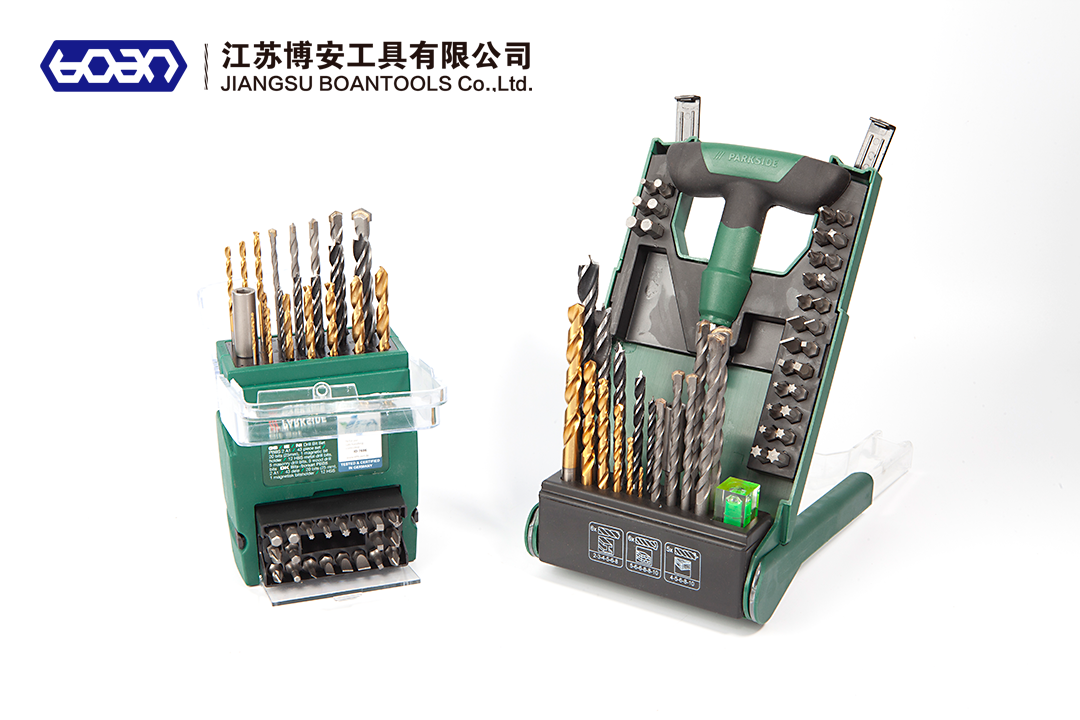
A product line may offer individual drill bits for replacement demand as well as boxed or cased sets for distribution programs. Sets can be organized by metric or inch sizes, application, range, or buyer-specified assortment.
For B2B purchasing, a set is more than a collection of sizes. Confirm the included diameters, quantity, case or box format, labeling, barcode or artwork requirements, master-carton information, and sample approval process.
BOAN TOOLS can discuss boxed or cased sets and buyer-specified private-label packaging requirements according to the requested product assortment and packaging details. This does not mean that the supplier is providing independent brand or retail-packaging strategy.<!– IMAGE 2: Insert after the sets section | Visual: Authorized BOAN boxed or cased drill bit set image showing the assortment and container without cropping the product details | Alt: “Boxed and cased drill bit sets for B2B distribution and private-label supply” | Source: BOAN Catalog.pdf, drill bit set page –>
Standards and Size Systems to Confirm
Standards and size systems are often the difference between a usable quotation and an ambiguous one. BOAN’s catalog includes references to HSS twist-drill families and standards such as DIN and ANSI formats. The buyer should still confirm the exact standard, diameter system, tolerance, point design, and dimensional table for the requested item.
Useful questions include:
- Is the range metric, inch, or both?
- Which standard applies to the requested drill family?
- Are the dimensions and tolerances documented in a drawing or catalog table?
- Are the shank and flute dimensions compatible with the target market’s equipment?
- Are samples measured against the same specification that will be used for batch production?
How to Turn the Seven Types into a Product-Line Plan
A practical line can start with a core family of HSS twist drills, then expand by adding a defined finish, a second length or shank format, HSCO options for more demanding materials, and boxed or cased sets for distribution. The sequence should follow actual customer demand and the buyer’s target channel.
When requesting a quotation from BOAN or another manufacturer, include the intended material, diameter range, standard, length, shank, finish, packaging format, sample requirement, and expected repeat-order plan. A clear request helps the supplier review matching catalog items or discuss a non-standard direction based on drawings and samples.
Final Takeaway
The most useful metal drill bit type is the one that matches the workpiece, machine, geometry, size system, and purchasing channel. Reviewing these seven dimensions allows a B2B buyer to compare suppliers on complete specifications rather than product names alone.
For a new or expanding product line, begin with the sizes and formats customers already request, then add specialized grades, lengths, shanks, or sets only when the application and channel justify them.